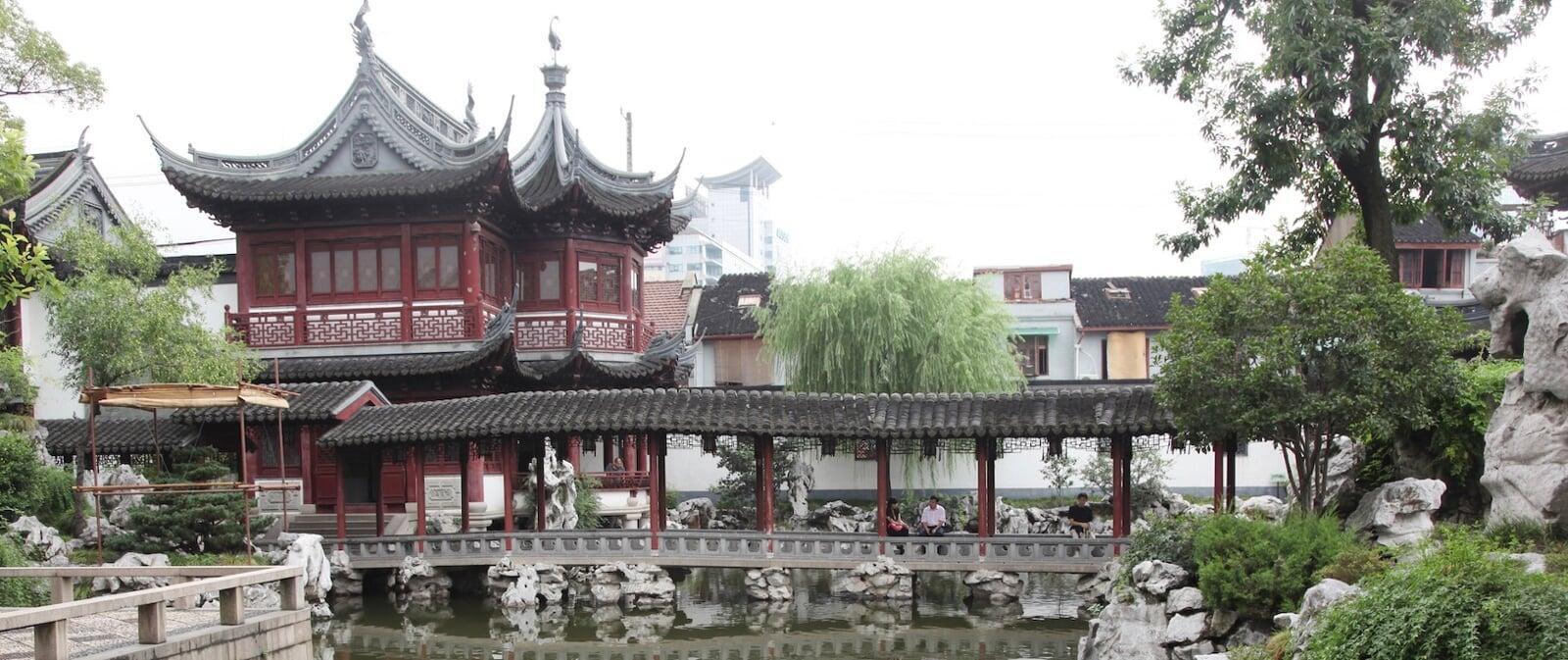
Yu Garden (豫园, Yùyuán) was originally constructed in 1559 during the Ming Dynasty under the reign of the Jiajing Emperor. It was commissioned by Pan Yunduan, a government official from Sichuan who served as a provincial administrator in Shanghai. Pan built the garden as a private retreat for his father, intending it to be a place of comfort and filial devotion. The name “Yu” (豫) conveys the idea of peace, satisfaction, and well-being — reflecting the Confucian value of honoring one’s parents.
Construction of the garden lasted nearly two decades and required significant financial investment. At its height, Yu Garden was considered one of the finest private gardens in southeastern China, designed in the refined Jiangnan style that integrates rockeries, ponds, pavilions, corridors, and ornamental plantings into a harmonious landscape. The layout was carefully engineered to create layered perspectives and the illusion of expansive natural scenery within a confined urban footprint.
However, following Pan Yunduan’s death, his family declined financially, and the garden gradually fell into disrepair. During the late Ming and Qing dynasties, ownership changed multiple times. Portions were damaged during periods of social unrest, including the Opium Wars in the 19th century, when foreign forces occupied parts of Shanghai.
In 1760, a group of local merchants restored and expanded the garden, adding the Inner Garden (Neiyuan) as a separate but connected section. Despite subsequent damage during the Taiping Rebellion and later conflicts in the early 20th century, Yu Garden continued to be repaired and preserved.
After the establishment of the People’s Republic of China in 1949, large-scale restoration efforts were undertaken, and the garden was officially reopened to the public in 1961. It was later designated as a nationally protected cultural heritage site. Today, Yu Garden stands as one of Shanghai’s most important historical landmarks — a rare surviving example of Ming-era private garden design within a rapidly modernized metropolis.